!Paleolithic Era: Secrets of Early Human Life and Survival
Paleolithic Era: Secrets of Early Human Life and Survival
Introduction
The Paleolithic era, often called the Old Stone Age, represents one of the longest and most fascinating chapters of human history. Stretching across a vast period of prehistory, it was a time when early humans developed tools, learned to control fire, adapted to changing climates, hunted and gathered food, created symbolic art, and gradually spread into different parts of the world.
Unlike later historical periods, the Paleolithic left no written records. Much of what we know comes from archaeological discoveries, fossils, stone tools, ancient settlements, animal remains, cave paintings, and other evidence preserved in the archaeological record. These discoveries offer remarkable clues about how our ancestors lived and adapted to challenging environments.
What Was the Paleolithic Era?
The word Paleolithic comes from Greek words meaning “old stone.” The period is commonly associated with the earliest stone-tool technologies and the development of early human societies. It began millions of years ago and continued until the transition toward agriculture and more settled ways of life.
The Paleolithic is generally divided into the Lower, Middle, and Upper Paleolithic. These divisions reflect major changes in technology, human behavior, and archaeological cultures rather than a single worldwide timeline that changed everywhere at exactly the same moment.
Life During the Paleolithic
Hunting and Gathering
Paleolithic communities generally relied on hunting, fishing, scavenging, and gathering wild plants and other available foods. Their diets varied dramatically depending on geography, climate, season, and the resources available in their environment.
Being able to move between different food sources was important. Groups could follow migrating animals, collect seasonal plants, find water, and relocate when local resources became scarce.
Stone Tools
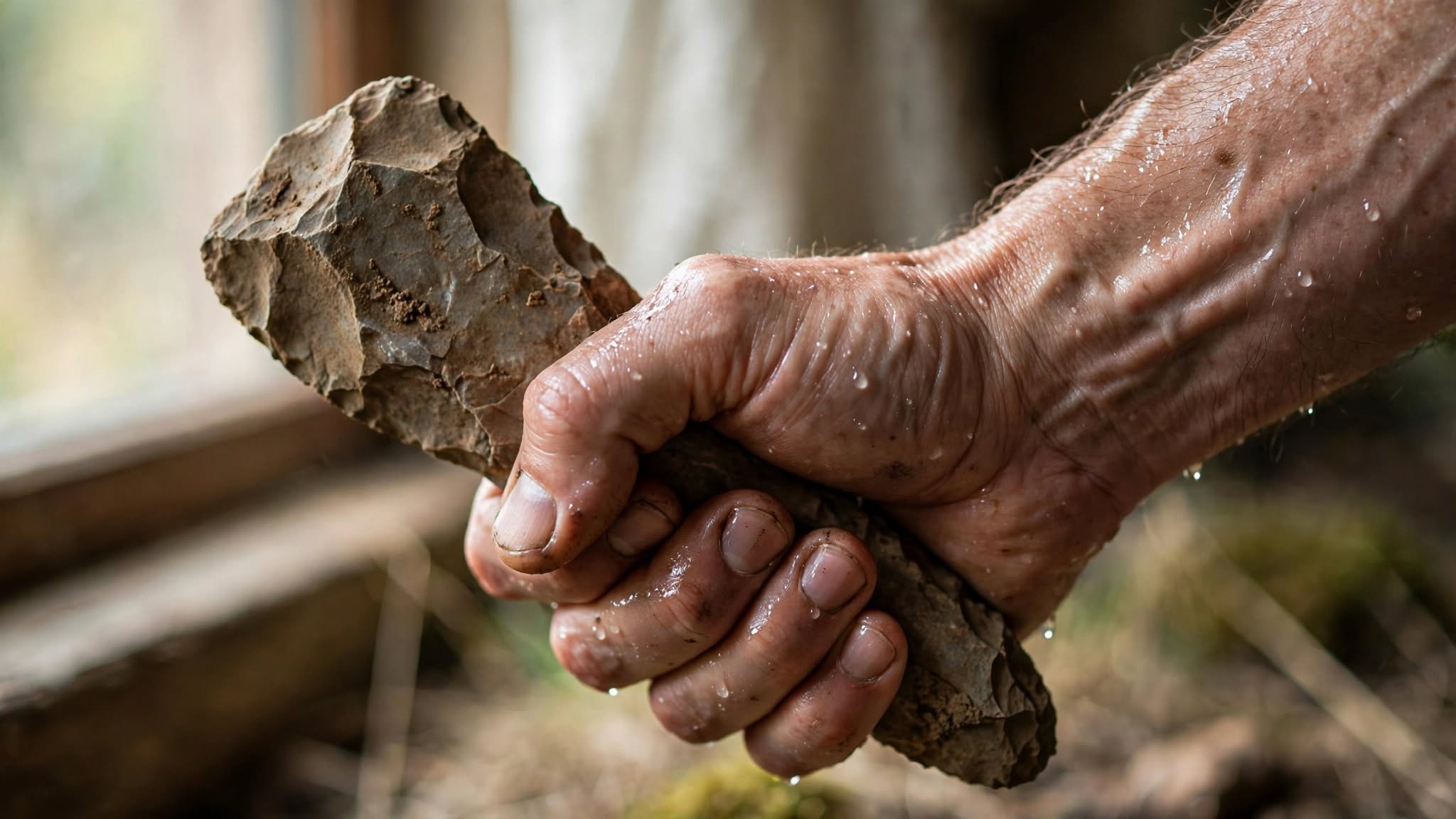
Stone tools are among the most important evidence from the Paleolithic. Early tool technologies included deliberately shaped stones used for cutting, scraping, chopping, and processing food and materials.
Over time, toolmaking became increasingly sophisticated. Different tool traditions demonstrate that prehistoric humans were capable of planning, selecting appropriate raw materials, and passing technical knowledge between generations.
Fire and Survival
Control of fire was another major development in human prehistory. Fire could provide warmth, protection, light, and a way to process food. It may also have helped people occupy colder environments and extend daily activity beyond daylight hours.
Exactly when and where different human groups developed consistent control over fire remains an active subject of archaeological research.
Life During the Ice Ages
Much of the later Paleolithic overlapped with periods of major climatic fluctuation, including Ice Age conditions. Large parts of the Northern Hemisphere experienced repeated advances and retreats of glaciers, while landscapes and ecosystems changed over time.
Humans had to adapt to these shifting conditions by changing hunting strategies, clothing, shelters, migration patterns, and food-gathering practices. Some groups lived in caves or rock shelters, while others constructed temporary shelters from available materials.
Paleolithic Art and Symbolism
One of the most intriguing aspects of Paleolithic life is prehistoric art. Cave paintings, engravings, carved objects, beads, pigments, and other artifacts provide evidence that some prehistoric communities expressed ideas through symbolic objects and images.
Famous cave-art traditions include representations of animals, human figures, abstract marks, and hand stencils. The exact meanings behind many prehistoric artworks remain uncertain, making them an enduring subject of archaeological debate.
Human Migration
The Paleolithic was also an era of major human movement. Different human populations gradually occupied environments across Africa, Europe, Asia, Australia, and eventually the Americas.
Migration was influenced by climate, food availability, geography, population movements, and interactions among different human groups. Modern archaeological and genetic research continues to refine our understanding of these movements.
10 Paleolithic Trivia Questions
1. What does the word Paleolithic mean?
A. New Stone B. Old Stone C. Bronze Age D. Metal Age
Answer: B. Old Stone
2. What was one of the main sources of food for Paleolithic communities?
A. Factory-produced food B. Wild plants and animals C. Cultivated wheat exclusively D. Processed grains
Answer: B. Wild plants and animals
3. Which material is especially associated with Paleolithic tools?
A. Plastic B. Steel C. Stone D. Concrete
Answer: C. Stone
4. Which major environmental phenomenon affected many later Paleolithic populations?
A. The Industrial Revolution B. The Ice Ages C. The Space Age D. The Digital Revolution
Answer: B. The Ice Ages
5. What type of evidence provides important information about Paleolithic life?
A. Written newspapers B. Archaeological artifacts and fossils C. Modern photographs D. Printed maps
Answer: B. Archaeological artifacts and fossils
6. Which activity was important for many Paleolithic communities?
A. Hunting and gathering B. Industrial manufacturing C. Factory farming D. Computer programming
Answer: A. Hunting and gathering
7. What is found in some famous Paleolithic caves?
A. Medieval manuscripts B. Prehistoric paintings and engravings C. Modern advertisements D. Printed books
Answer: B. Prehistoric paintings and engravings
8. Why was fire potentially important to Paleolithic humans?
A. It provided warmth and helped process food B. It produced electricity C. It powered vehicles D. It created plastic
Answer: A. It provided warmth and helped process food
9. What does archaeological evidence suggest about Paleolithic humans?
A. They lived in exactly the same way everywhere B. Their lifestyles varied according to environment and available resources C. They used modern technology D. They all lived permanently in cities
Answer: B. Their lifestyles varied according to environment and available resources
10. What major development eventually helped bring the Paleolithic to an end in many regions?
A. The development of agriculture and more settled communities B. The invention of computers C. The construction of skyscrapers D. The invention of automobiles
Answer: A. The development of agriculture and more settled communities
Step-by-Step Guide: Launching a Quiz Channel from Scratch
Creating a trivia channel around the Paleolithic era gives you a strong niche because the subject naturally combines prehistoric humans, ancient survival, early tools, Ice Age environments, cave art, hunting, food, migration, and surprising archaeological discoveries. A creator can turn these themes into short, curiosity-driven quiz videos without needing to appear on camera.
1. Choose a focused Paleolithic angle
Start by deciding whether your content will focus on early human life, prehistoric animals, Stone Age tools, cave paintings, ancient diets, Ice Age geography, archaeological discoveries, or survival challenges.
2. Build a question spreadsheet
Create a CSV containing questions, multiple-choice answers, correct answers, titles, and other information required by your production workflow. One batch could focus on Paleolithic survival while another covers prehistoric animals or ancient tools.
3. Import the CSV
QuizViral AI can be used to turn spreadsheet-based content into batches of quiz videos, reducing repetitive production work and making large-scale content creation more manageable.
4. Add engaging background loops
Moving backgrounds such as Minecraft parkour, space scenes, nature footage, wilderness environments, rocky landscapes, or prehistoric-style scenery can keep the visual layer active while viewers concentrate on the quiz.
5. Generate natural AI voiceovers
Natural-sounding AI narration can read questions, answer choices, countdowns, and answer reveals. A conversational voice can make a question such as “Could you survive the Paleolithic?” feel like an interactive challenge.
6. Review before publishing
Check historical claims, answers, pronunciation, visuals, timing, licensing, and overall quality before publishing. Batch production can save time, but human review remains important for factual accuracy.
Monetizing Your Channel: Beyond Ad Revenue
YouTube advertising can eventually become one part of a quiz channel's income, but creators can also develop other revenue streams. The YouTube Partner Program has specific eligibility requirements, and Shorts creators commonly target the 10 million valid public Shorts views threshold within 90 days for the relevant Shorts ad-revenue pathway, alongside other requirements.
Affiliate marketing
A Paleolithic and archaeology audience may be interested in history books, educational resources, museum products, documentaries, and learning materials. Affiliate recommendations work best when they are closely connected to the audience's interests.
Print-on-demand merchandise
Prehistoric themes can translate naturally into original shirts, mugs, posters, and other products. Designs could feature Stone Age humor, prehistoric animals, ancient tools, or original educational artwork.
Digital trivia downloads
Creators can sell printable Paleolithic quiz packs, family trivia games, classroom activity sheets, prehistoric fact collections, and themed question bundles. Digital products can complement free video content while creating an additional revenue stream.
Build a direct audience
An email list or community can help creators maintain a relationship with viewers beyond a single platform. Free prehistoric trivia downloads can be used as an incentive to build an audience interested in future quizzes and digital products.
Answers to Common Questions
How much time does a Paleolithic quiz channel take to run?
The time commitment depends on how much of the workflow is automated. Batch preparation, spreadsheet imports, automated voiceovers, and reusable video formats can reduce repetitive production work, but creators should still allocate time for research, fact-checking, quality control, publishing, and audience analysis.
How can I make my channel original?
Originality comes from more than changing the background. Develop recognizable quiz formats, original questions, consistent narration, distinctive hooks, explanations, and a recognizable visual identity. Formats such as “Could You Survive the Stone Age?” or “Guess the Prehistoric Animal” can give the channel recurring themes.
How can I keep the channel copyright-safe?
Use footage, music, images, and sound effects that you created yourself, have permission to use, or are properly licensed for your intended use. Do not assume that content found through search engines or social platforms is free to reuse. Keep records of relevant licenses and permissions when appropriate.
Conclusion
The Paleolithic era offers an enormous range of fascinating subjects, from ancient tools and hunting strategies to Ice Age environments, cave art, human migration, and the earliest evidence of symbolic behavior. Because each subject can become a question, challenge, mystery, or surprising fact, the era provides a flexible foundation for educational trivia content.
Whether exploring how early humans survived harsh environments or asking viewers to identify prehistoric tools and animals, Paleolithic history offers countless opportunities to turn ancient evidence into memorable modern learning experiences.