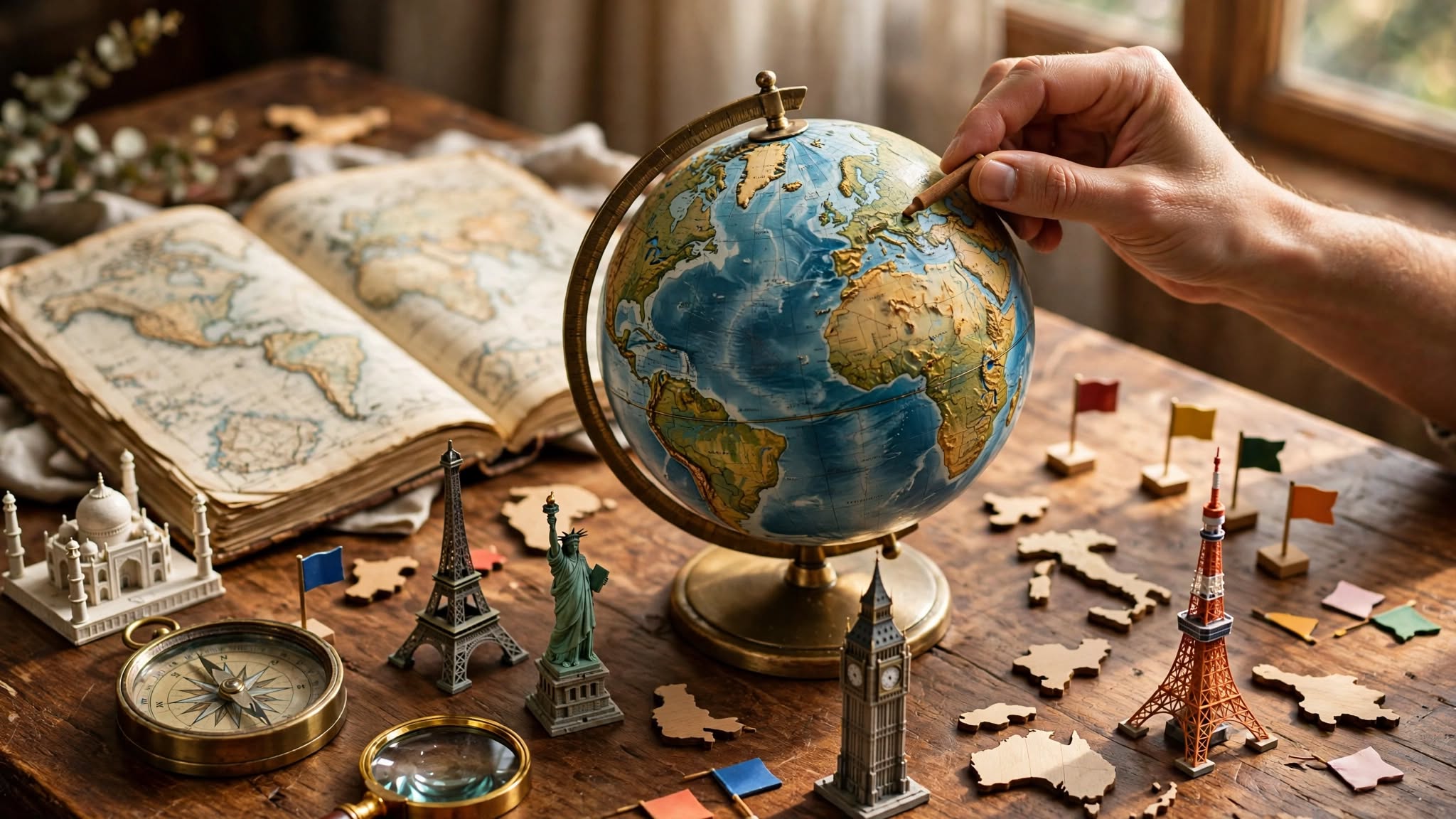
!World Geography Trivia Quiz with Country Capitals: 10
World Geography Trivia Quiz with Country Capitals: Explore the World One Question at a Time
How well do you really know the world? You might recognize the Eiffel Tower, identify the shape of Australia on a map, or know that the United States is home to Washington, D.C. But can you name the capital of Kazakhstan, identify the country with the most neighboring nations, or distinguish the flags of countries that share similar colors and designs? A world geography trivia quiz with country capitals turns these challenges into an exciting test of knowledge that can entertain viewers while helping them discover more about the planet.
Geography is an ideal subject for interactive trivia because it combines visual recognition, memory, culture, history, and general knowledge. Every question gives participants an opportunity to travel mentally to another part of the world. One moment, they might be identifying the capital of a European country; the next, they could be locating an island nation in the Pacific or recognizing a national flag from Africa. This variety keeps quizzes interesting and gives creators plenty of material for fresh content.
For viewers, a world geography challenge is more than a collection of questions and answers. It is a fun way to test what they already know, discover unfamiliar places, and improve their understanding of international geography. Questions about country capitals are particularly effective because they range from familiar destinations such as Paris, London, and Tokyo to less commonly remembered capitals such as N'Djamena, Thimphu, and Dushanbe. A well-designed quiz can gradually increase in difficulty, allowing beginners to participate while giving experienced geography enthusiasts a genuine challenge.
Why World Geography Quizzes Work So Well for Online Audiences
Geography trivia has several qualities that make it suitable for YouTube Shorts, Instagram Reels, TikTok, Pinterest videos, and other short-form platforms. First, the subject is universally understandable. People from different countries and age groups can participate without needing specialized knowledge. Second, geography offers endless possibilities for visual questions. A creator can display a flag, highlight a country on a map, show a famous landmark, or present four possible capital cities and ask viewers to choose the correct answer.
The interactive format also encourages viewers to pause, think, and respond. Instead of simply watching a video, they become part of the experience. A short countdown before revealing the answer creates anticipation, while a quick explanation after the reveal makes the content educational rather than just entertaining. Encouraging viewers to share their scores or comment with the number of correct answers can help create a community around the channel.
Strategies for Creating an Engaging World Geography Quiz
Successful geography trivia content needs more than random questions. Start by organizing your quiz into clear categories, such as European capitals, Asian capitals, African countries, island nations, national flags, continents, and famous geographical landmarks. This approach makes it easier to plan multiple episodes and gives viewers a reason to return for different challenges.
Next, create a balanced difficulty curve. Begin with accessible questions that help viewers build confidence, introduce moderately difficult questions in the middle, and finish with a challenging question that encourages people to test the limits of their knowledge. For example, a beginner-level question might ask for the capital of France, while a harder question could ask viewers to identify the capital of Bhutan or the country where a particular geographical landmark is located.
Accuracy should always come before speed. Verify every answer using reliable geographical references, particularly when dealing with countries that have changed their capital arrangements, cities with different official and administrative roles, or territories whose political status is disputed. Make sure that every multiple-choice question has one clearly correct answer and that the incorrect options are plausible without creating confusion.
Presentation matters just as much as question quality. Use clear maps, recognizable flag images, attractive backgrounds, readable answer choices, and consistent visual styling. Keep each question on screen long enough for viewers to read and respond. A countdown of five to eight seconds can work well for many short-form quizzes, although more difficult questions may need additional time. When revealing the answer, include a brief fact about the country or its capital so viewers leave with something new to remember.
Turn Geography Knowledge into a Consistent Content Channel
For creators hoping to grow an educational or trivia-focused channel, geography provides a sustainable content opportunity. Instead of publishing unrelated questions without a plan, build recognizable series such as Guess the Capital in Five Seconds, Can You Identify the Country by Its Flag?, Easy to Expert World Geography Challenge, and How Many Countries Can You Locate on a Map? Each series can have its own visual identity while remaining part of a larger geography brand.
Consistency is important, but it should not come at the expense of originality. Experiment with different question formats, observe which topics generate meaningful engagement, and use audience feedback to plan future episodes. You could create weekly regional challenges, special quizzes about island countries, or a monthly championship in which viewers attempt to answer increasingly difficult questions. Playlists can organize these videos into learning paths, making it easier for new visitors to explore the channel.
This is where QuizViral AI can help simplify the production process. Rather than manually building every quiz video from scratch, creators can prepare their questions, multiple-choice options, correct answers, and other required details in a structured CSV file. QuizViral AI supports automated bulk video generation through CSV imports, helping transform a prepared collection of trivia questions into multiple video assets more efficiently. This can make it easier to produce themed geography episodes, prepare content batches, and maintain a consistent publishing schedule.
Automation, however, should support creativity rather than replace it. Review every generated video, check the accuracy of the answers, use properly licensed visual assets, and make sure each episode offers a clear and enjoyable experience. Add your own explanations, distinctive presentation style, and creative question sequences so that viewers recognize the value of your channel instead of seeing repetitive, interchangeable quiz videos.
Start Exploring the World Through Trivia
A world geography trivia quiz with country capitals offers a simple but powerful combination: entertainment, learning, and friendly competition. It can help viewers discover unfamiliar countries, remember important capitals, recognize national flags, and develop a stronger understanding of the world. For content creators, it provides a flexible subject with enough variety to support hundreds of original questions and recurring video series.
Whether you are launching a new trivia channel or expanding an existing educational brand, focus on accurate questions, engaging visuals, clear explanations, and a consistent publishing strategy. Use audience responses to discover what people enjoy, introduce harder challenges as your community grows, and make every video worth watching. With thoughtful planning and tools such as QuizViral AI to streamline bulk production, you can spend less time repeating manual editing tasks and more time creating geography challenges that encourage viewers to think, learn, compete, and come back for another round.
Explore Intriguing Borders, Obscure Capitals, and Challenging Country Geography Trivia
A memorable world geography trivia quiz with country capitals should do more than ask viewers to match familiar countries with famous cities. The most engaging challenges take participants beyond basic geographical knowledge and introduce unusual borders, surprising capital-city facts, landlocked nations, remote island countries, and places that are easy to confuse on a map. These subjects are particularly valuable for vertical video creators because they provide strong visual hooks and encourage viewers to stop scrolling to test themselves.
Consider a question about Lesotho. This small African country is completely surrounded by South Africa, making it one of the world's most distinctive geographical examples. A vertical video could begin with a map highlighting South Africa before revealing the smaller country enclosed within its borders. Ask viewers to identify the country, provide four possible answers, and reveal Lesotho after a short countdown. The unusual geographical situation gives the question an immediate point of interest and makes the answer easier to remember.
1. Turn Unusual International Borders into Visual Challenges
International borders offer some of the best opportunities for creative geography questions. Instead of showing a country name immediately, display a simplified map and ask viewers to identify the country based on its neighbors. You can also highlight an unusual border arrangement and challenge participants to explain what makes it distinctive.
For example, the Gambia is a narrow country largely surrounded by Senegal, apart from its Atlantic coastline. This creates an excellent map-based question because its shape stands out when compared with neighboring countries. Another interesting example is Baarle-Hertog and Baarle-Nassau, a collection of Belgian and Dutch territories that creates an unusually complicated international boundary through a shared town. These examples can inspire questions about enclaves, exclaves, coastal borders, and countries surrounded by other countries.
For vertical videos, use a zoomed-in map rather than displaying an entire world map in every episode. Begin with the highlighted border, slowly zoom out to reveal the surrounding region, and keep the four answer choices visible in a clear lower-screen layout. Avoid adding so many labels that the map becomes difficult to understand on a mobile screen.
2. Make Obscure Capitals the Ultimate Geography Test
Familiar capital cities are useful for introductory questions, but lesser-known capitals can make a geography series much more challenging. Many viewers can identify London, Rome, and Tokyo, yet may hesitate when asked about the capitals of Bhutan, Kyrgyzstan, or Madagascar.
For example, Thimphu is the capital of Bhutan, Bishkek is the capital of Kyrgyzstan, and Antananarivo is the capital of Madagascar. These names create opportunities for pronunciation challenges, spelling-based rounds, and map identification games. A particularly interesting question can ask viewers to identify the capital of a country before showing its national flag and geographical location.
Another useful approach is to explore countries with more complicated capital arrangements. South Africa, for instance, has three capital cities with different governmental functions: Pretoria is the administrative capital, Cape Town is the legislative capital, and Bloemfontein is traditionally recognized as the judicial capital. A question that simply asks for the capital of South Africa can therefore be ambiguous. Make the wording precise by asking which city is the administrative capital.
3. Build a Vertical Video Format That Holds Attention
Vertical geography videos need to communicate the challenge quickly. Viewers should understand the question before they lose interest, and the answer should feel rewarding. A practical format is to divide each video into four visual stages:
- Opening hook: Introduce an unusual geographical fact or a challenging map image.
- Question: Display one clearly worded question and four answer choices.
- Thinking time: Use a short countdown that gives viewers time to choose.
- Answer and explanation: Highlight the correct answer and add one memorable geographical fact.
For example, a video might open with the line, "This country is completely surrounded by another country. Can you name it?" A map then highlights Lesotho inside South Africa, followed by four options. After the countdown, reveal the answer and explain that Lesotho is an independent country entirely enclosed by South African territory.
Use a consistent font, strong contrast, and large answer choices. Keep important text away from the extreme top and bottom edges, where platform interface elements may cover it. Make sure maps and flags are large enough to recognize on a phone. If you use animations, keep them purposeful: a moving border highlight or a gradual map zoom is more useful than distracting effects that compete with the question.
4. Use QuizViral AI to Organize and Scale Geography Content
Creating individual quiz videos manually can become time-consuming when you want to publish regularly. QuizViral AI offers a way to streamline this process through automated bulk video generation from CSV imports. Instead of preparing every video as a separate editing project, creators can organize multiple questions and answers in a spreadsheet, prepare the CSV file in the required structure, and use it to generate a batch of quiz videos.
For a practical example, imagine planning a 30-video series called Border Mysteries and Hidden Capitals. You could divide the series into three groups: 10 unusual international borders, 10 lesser-known capital cities, and 10 country identification challenges. Each CSV row can contain a question, four answer options, the correct answer, and an explanation if supported by your chosen workflow. This gives you a structured production plan rather than a collection of disconnected ideas.
Before importing the file, check that every question has exactly four options, the answer matches one of those options, and the explanation does not contradict the question. Pay special attention to capital-city terminology, disputed boundaries, and countries with multiple capital functions. After generation, review the videos individually to check text placement, pronunciation, map accuracy, timing, and visual consistency. Automation can speed up production, but human fact-checking and creative direction remain essential.
You can also use performance data to improve future batches. If viewers frequently comment on questions about unusual borders, prepare another regional border challenge. If obscure capitals generate more discussion, create a follow-up series focused on smaller countries and island nations. This approach turns audience interest into a useful content-planning signal without sacrificing accuracy.
5. Ten World Geography Trivia Questions with Country Capitals
Use the following sample questions as a ready-to-adapt foundation for your geography videos. They combine unusual borders, lesser-known capitals, country identification, and geographical knowledge. Each question has four possible answers and a clear explanation to make the reveal educational as well as entertaining.
#### Question 1: Which country is completely surrounded by South Africa?
- A. Eswatini
- B. Lesotho
- C. Botswana
- D. Namibia
Correct Answer: B. Lesotho. Lesotho is an independent country entirely enclosed by South Africa. Its mountainous landscape makes it a particularly interesting destination for geography enthusiasts.
#### Question 2: What is the capital city of Bhutan?
- A. Kathmandu
- B. Dhaka
- C. Thimphu
- D. Vientiane
Correct Answer: C. Thimphu. Thimphu is Bhutan's capital and largest city. It is located in the western part of the country in the Himalayan region.
#### Question 3: Which country has the capital city of Antananarivo?
- A. Mauritius
- B. Madagascar
- C. Seychelles
- D. Mozambique
Correct Answer: B. Madagascar. Antananarivo is the capital of Madagascar, an island country off the southeastern coast of Africa. Its location makes it an excellent subject for island-geography questions.
#### Question 4: Which country surrounds the Italian territory of San Marino?
- A. France
- B. Austria
- C. Switzerland
- D. Italy
Correct Answer: D. Italy. San Marino is a small independent country completely surrounded by Italy. Its capital is also called San Marino.
#### Question 5: What is the capital of Kyrgyzstan?
- A. Tashkent
- B. Bishkek
- C. Dushanbe
- D. Ashgabat
Correct Answer: B. Bishkek. Bishkek is the capital of Kyrgyzstan in Central Asia. Its position near the northern edge of the country makes it useful for map-based regional quizzes.
#### Question 6: Which African country has a long, narrow shape and is largely surrounded by Senegal?
- A. The Gambia
- B. Guinea
- C. Liberia
- D. Togo
Correct Answer: A. The Gambia. The Gambia follows the course of the Gambia River and is largely surrounded by Senegal, with a coastline along the Atlantic Ocean. Its unusual shape makes it especially recognizable on a regional map.
#### Question 7: What is the capital city of Mongolia?
- A. Astana
- B. Ulaanbaatar
- C. Urumqi
- D. Samarkand
Correct Answer: B. Ulaanbaatar. Ulaanbaatar is the capital of Mongolia, a large landlocked country located between Russia and China. It is the country's political and economic center.
#### Question 8: Which country has three capital cities serving different governmental functions?
- A. Kenya
- B. Egypt
- C. South Africa
- D. Nigeria
Correct Answer: C. South Africa. Pretoria serves as the administrative capital, Cape Town as the legislative capital, and Bloemfontein as the judicial capital traditionally recognized in this arrangement. The question should specify the function whenever asking viewers to name one of its capitals.
#### Question 9: What is the capital of Laos?
- A. Phnom Penh
- B. Hanoi
- C. Vientiane
- D. Yangon
Correct Answer: C. Vientiane. Vientiane is the capital of Laos, a landlocked country in Southeast Asia. The city is situated along the Mekong River near the border with Thailand.
#### Question 10: Which two countries share the unusual divided town of Baarle?
- A. Belgium and the Netherlands
- B. Germany and Poland
- C. France and Spain
- D. Austria and Hungary
Correct Answer: A. Belgium and the Netherlands. Baarle is known for its complex patchwork of Belgian and Dutch territories. The boundary passes through streets and buildings, making it a fascinating example of how international borders can shape everyday geography.
6. Keep Your Questions Accurate, Fresh, and Worth Sharing
A strong geography channel earns trust by treating facts carefully. Country names, capital cities, national flags, and international boundaries can change or involve complicated political circumstances. Check authoritative references before publishing, especially when covering recently renamed cities, administrative capitals, overseas territories, and disputed borders. Avoid questions with multiple defensible answers, and explain any unusual terminology directly in the answer reveal.
Variety is another important part of long-term growth. Rotate between capital-city challenges, flag identification, neighboring-country questions, unusual borders, island geography, and map-based puzzles. You can also create themed collections for different regions, giving viewers a reason to follow the series and test their knowledge over time. Keep a record of previously used questions so that future episodes introduce genuinely new challenges rather than repeating the same familiar facts.
Finally, remember that bulk production is only one part of building a successful channel. Strong hooks, original explanations, accurate visual material, recognizable branding, and meaningful audience interaction help distinguish your videos. QuizViral AI can reduce repetitive production work through CSV-based bulk generation, while your research and creative decisions give every quiz its own identity. Combine those strengths and even a single unusual border or an unfamiliar capital can become the starting point for an engaging geography series that viewers want to share.
Step-by-Step Guide: Launching a Quiz Channel from Scratch
Imagine turning your interest in world geography into a channel where viewers compete to identify obscure capitals, recognize national flags, and solve unusual border puzzles. You do not need a large production team or professional editing experience to get started. With a carefully planned question bank and QuizViral AI's 1-click bulk generation from CSV spreadsheet imports, you can build a repeatable workflow for producing geography trivia videos.
Step 1: Choose a Clear Geography Channel Concept
Start by deciding what makes your channel recognizable. Rather than covering every possible trivia subject, focus on country capitals and world geography challenges. You could build recurring series such as "Guess the Capital," "Border Mystery Challenge," "Identify the Country by Its Flag," and "Five-Second World Geography Test."
A focused concept helps viewers understand what they will get when they subscribe. It also makes content planning easier because every new episode can explore a different country, region, geographical feature, or capital city.
Step 2: Research and Prepare Your Questions
Create a spreadsheet containing your questions, four answer options, the correct answer, and a short explanation. For example, a question about Bhutan could ask viewers to identify its capital, with Thimphu as the correct answer. Another episode might show a map of Lesotho and ask why its location is unusual.
Start with a manageable batch of 30 questions. Divide them into three groups: 10 country-capital questions, 10 unusual-border challenges, and 10 flag or country-identification questions. Verify every answer before adding it to the spreadsheet. Be precise when a country has multiple capital functions, and avoid ambiguous questions about disputed territories.
Step 3: Organize Your CSV for Bulk Video Generation
Once your questions are ready, arrange them in the CSV structure supported by your QuizViral AI workflow. A typical spreadsheet might contain these fields:
- Question: The geography challenge displayed on screen.
- Option A: The first possible answer.
- Option B: The second possible answer.
- Option C: The third possible answer.
- Option D: The fourth possible answer.
- Correct Answer: The verified answer.
- Explanation: A short educational fact for the reveal.
For example, your CSV could contain a question asking, "What is the capital of Kyrgyzstan?" with Bishkek among the four choices. The answer reveal can then include a short explanation that Kyrgyzstan is a landlocked country in Central Asia. Keep the wording concise so viewers can read it comfortably on a mobile screen.
Step 4: Generate Videos with QuizViral AI
Import your prepared CSV into QuizViral AI and use its 1-click bulk generation workflow to turn the spreadsheet questions into multiple quiz videos. Instead of manually creating each question screen, answer reveal, and video sequence, you can use the bulk workflow to speed up repetitive production tasks.
Choose a consistent visual style for your geography channel. Make the country name, question, answer choices, and countdown easy to read. Use a clear reveal animation to highlight the correct answer, followed by a short explanation. Review the generated videos before publishing to catch incorrect text, formatting problems, mismatched answers, or awkward timing.
Step 5: Select Background Loops and Natural AI Voiceovers
Background footage can help keep a vertical quiz visually engaging while viewers consider their answers. You can experiment with different styles depending on the atmosphere of the episode:
- Minecraft loops: Colorful parkour or exploration footage can create a playful atmosphere for quick capital-city challenges.
- Space loops: Planetary views, stars, and animated journeys across Earth can complement global geography and country-location questions.
- Nature loops: Mountains, rivers, forests, coastlines, and aerial landscape footage work especially well for questions about countries and physical geography.
Use footage that supports the quiz rather than distracting from it. For example, a question about Bhutan could pair well with mountain scenery, while a challenge about island nations could use ocean or coastline footage. Make sure all background clips are properly licensed or otherwise authorized for your intended use.
Natural AI voiceovers can make the experience more accessible and help establish a recognizable presentation style. Choose a voice with clear pronunciation, particularly for unfamiliar names such as Antananarivo, Ulaanbaatar, and Thimphu. Listen to the generated audio before publishing, correct pronunciation problems where necessary, and synchronize the narration with the question and answer reveal.
Step 6: Publish Consistently and Improve from Audience Feedback
Start with a realistic publishing schedule that you can maintain. For example, publish one geography quiz each day for the first 30 days, provided you can review every video properly. Use descriptive titles such as "Can You Name These 10 World Capitals?" and write captions that invite viewers to share their scores.
Monitor audience retention, comments, shares, and repeat viewing. If viewers respond particularly well to unusual border questions, develop another series around enclaves, landlocked countries, and neighboring nations. If capital-city challenges attract more engagement, create themed episodes covering Africa, Asia, Europe, and the Pacific. Use analytics to guide your next batch rather than assuming every topic will perform equally well.
Monetizing Your Channel: Beyond Ad Revenue
Building a geography trivia channel can eventually create several income opportunities. YouTube advertising is one possibility, but relying on ad revenue alone can make a creator's business vulnerable to changing platform rules, view counts, and advertising rates. A stronger approach is to build multiple products and income streams around the audience's interest in geography and learning.
Understand the YouTube Partner Program Requirements
For the full YouTube Partner Program advertising-revenue eligibility route that uses Shorts, creators generally need 1,000 subscribers and 10 million valid public Shorts views within 90 days, along with the applicable policy, account, and review requirements. Meeting the numerical threshold does not guarantee acceptance; YouTube must still review the channel for compliance.
There is also an alternative eligibility route based on public long-form watch hours, and YouTube offers an earlier entry tier in eligible countries for certain fan-funding and shopping features. Requirements and feature availability can change, so check YouTube's official Partner Program guidance before making financial plans.
Most importantly, do not treat automated video production as a shortcut to monetization approval. A channel built from repetitive, minimally differentiated videos may struggle to demonstrate originality and meaningful viewer value. Add original research, interesting explanations, carefully selected maps, distinctive narration, and thoughtful editing to make every geography quiz worthwhile.
1. Affiliate Marketing: Recommend Useful Geography Products
Affiliate marketing allows creators to earn a commission when viewers purchase products through qualifying links. A geography-focused channel can recommend products that genuinely support learning and exploration, such as world atlases, educational globes, map puzzles, geography board games, travel guides, and study resources.
For example, after publishing a series about world capitals, you could create a companion video showing how a physical globe or atlas helps learners remember country locations. Include relevant affiliate links in the video description where permitted, explain that they are affiliate links, and recommend products based on their usefulness rather than simply choosing items with higher commissions.
2. Print-on-Demand Merchandise: Turn Geography into a Brand
Print-on-demand merchandise can turn your channel identity into products without requiring you to purchase and store inventory in advance. You could design geography-themed T-shirts, mugs, posters, tote bags, and notebooks featuring original map-inspired illustrations or playful phrases such as "Capital City Champion" and "My World Geography Score Is 9/10."
Another idea is to create a collection based on geographical regions, using original illustrations of mountains, oceans, continents, and compass designs. Avoid using copyrighted map artwork, protected logos, or official emblems without permission. Check the platform's production costs, shipping charges, and profit margins before setting retail prices.
3. Digital Trivia Downloads: Sell Learning Resources
Digital downloads are particularly suitable for a geography trivia audience because viewers already enjoy testing and improving their knowledge. You can turn your research into printable products such as country-capital flashcards, regional geography worksheets, flag-identification activities, map-labeling exercises, and family trivia packs.
For example, a digital product called "The 100-Country Capital Challenge" could include 100 verified country-capital questions, multiple-choice answer sheets, a separate answer key, and a printable scorecard. You could also offer a more advanced version covering obscure capitals and unusual borders. Make the resource visually attractive, easy to print, and accurate. A small free sample can help viewers understand the product before purchasing the complete pack.
Build an Audience That Supports More Than One Product
These income streams work best when they are connected to the same audience. A viewer who enjoys your capital-city quizzes might also want a printable study pack, an atlas recommendation, or a geography-themed notebook. Use your videos to demonstrate the value of these resources rather than filling every description with sales messages.
QuizViral AI can help you maintain a regular supply of quiz content through bulk CSV-based production, leaving more time for research, product development, and audience engagement. The long-term goal should be to build a recognizable educational brand with original content and useful products, not simply to publish the largest possible number of videos.
Answers to Common Questions
1. How much time does it take to run a geography quiz channel?
The time commitment depends on how much research, editing, and review you do yourself. Preparing a batch of questions can take longer initially, particularly when checking obscure capitals, unusual borders, and geographical terminology. Once you have a reliable spreadsheet structure, QuizViral AI's bulk CSV generation can reduce repetitive video-production work. However, you should still review the generated videos, verify answers, check voiceover pronunciation, and prepare titles and descriptions. A beginner could start with a small batch of five to seven videos per week and adjust the schedule according to the time available and the quality they can consistently maintain.
2. How can I make my geography quiz channel original instead of looking like hundreds of other quiz channels?
Give your channel a distinctive editorial identity. Instead of relying entirely on basic capital questions, develop original recurring themes such as "The Border Puzzle of the Week," "Capitals Most People Mispronounce," or "Find the Country from Its Neighbors." Add short explanations that teach viewers something beyond the correct answer. Use your own question research, original scripts, distinctive narration, and thoughtfully selected maps or illustrations. You can use QuizViral AI to streamline bulk production, but the questions, explanations, creative direction, and final presentation should demonstrate your own contribution. Avoid publishing identical templates with only country names changed.
3. Is it safe to use background videos, maps, flags, and AI voiceovers from a copyright perspective?
It can be safe when you have the necessary rights and follow the relevant licenses and platform policies. Do not assume that a video found online, a Minecraft gameplay clip, a space animation, or a nature recording is free to reuse. Use footage you created yourself, material with a suitable license, or assets for which you have permission. Check the specific terms for maps, photographs, music, fonts, and other visual elements as well. National flags are generally treated differently from copyrighted creative artwork, but particular flag illustrations, designs, and associated emblems may have separate restrictions. AI-generated voiceovers do not automatically make a video copyright-safe or guarantee monetization eligibility. Keep records of asset licenses, review commercial-use permissions, and make sure your finished quizzes offer original educational value.
A successful world geography trivia channel is built on a combination of curiosity, accuracy, consistency, and creativity. Start with country capitals and unusual borders, turn your strongest questions into engaging vertical videos, and use QuizViral AI to make batch production more manageable. As your audience grows, expand into printable trivia products, useful affiliate recommendations, and original geography merchandise. With a clear identity and a commitment to quality, a simple quiz channel can develop into a sustainable educational content brand.